This article is intended solely for strategy research and market structure analysis. It does not constitute investment advice and should not be interpreted as a guarantee of future performance.
Why Do So Many Traders Enter at the Wrong Time?
Many traders have experienced the same situation.
The price breaks out.
They immediately jump in.
Moments later, the market pulls back.
Their stop-loss is triggered.
Then the price continues moving higher.
Many people believe:
The market is deliberately targeting me.
In reality, most of the time, the problem is not that the market moved in the wrong direction.
The real issue is:
The entry lacked an advantage.
For any trend-following strategy, whether the market eventually moves up or down is simply the outcome.
What truly determines the quality of a trade is:
- Whether you are trading in the direction of the trend.
- Whether the trade offers a favorable risk-to-reward ratio.
- Whether you wait for genuine market confirmation before entering.
Therefore, the goal of strategy research should not simply be finding buy or sell signals.
Instead, it should focus on one question:
Which price locations are truly worth risking capital?
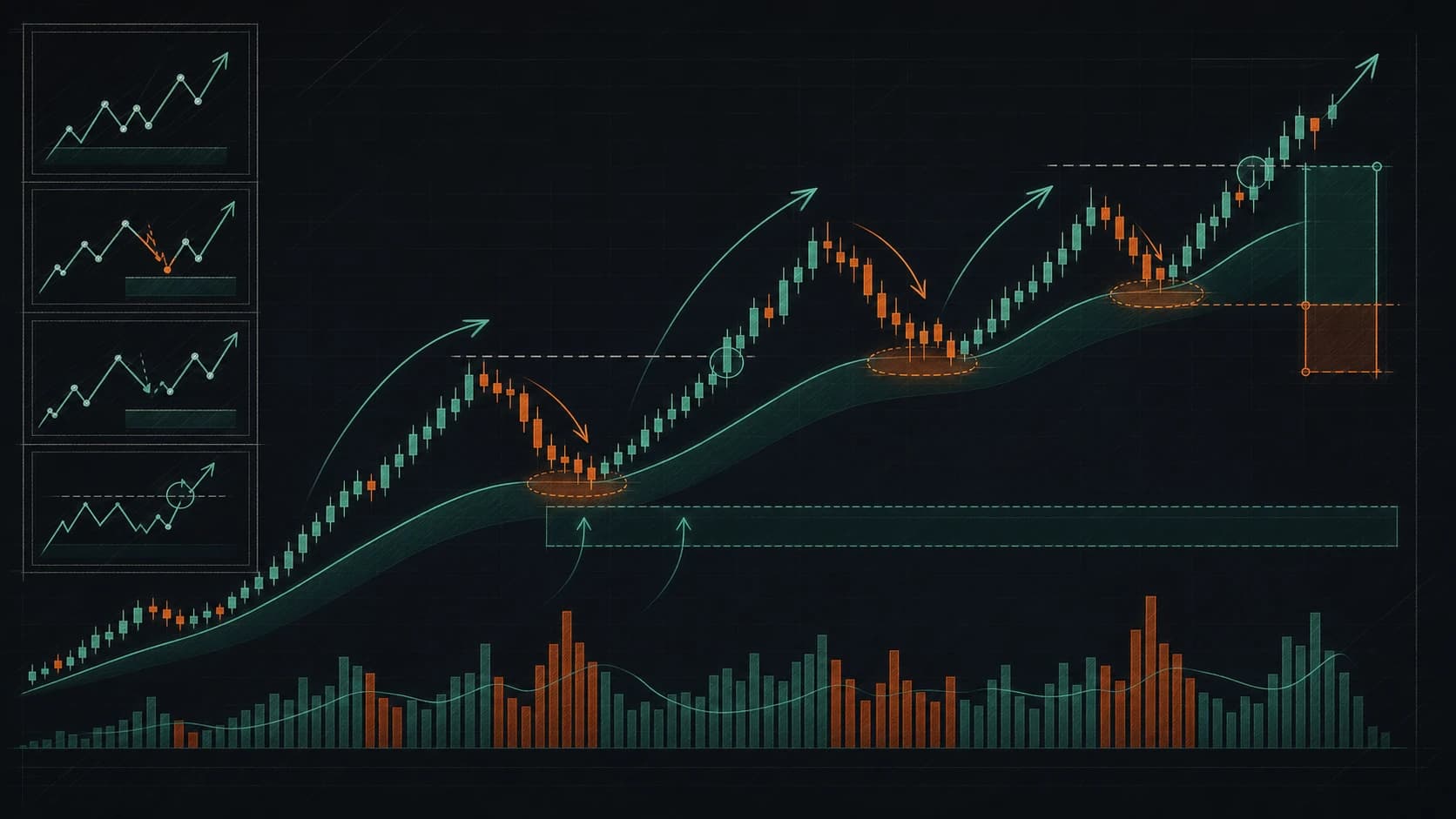
Most Trending Markets Spend More Time Pulling Back Than Rallying
If you study Bitcoin's historical price action over the past several years, you'll notice something interesting.
Healthy uptrends rarely move in a straight line.
Instead, they usually follow a structure like this:
Impulse Higher

↓

Pullback

↓

Continuation

↓

Another Pullback

↓

Break Above Previous High
A pullback does not necessarily mean the trend has ended.
More often than not, it represents the market rebuilding buying pressure before the next move.
Therefore, what deserves more attention is not how to chase breakouts.
It is understanding:
Whether a pullback is still part of the existing trend.
A Trading Framework Worth Studying
The following is a commonly used trend-following framework.
It is not a fixed strategy.
Instead, it serves as a research framework that can be continuously improved across different markets, trading instruments, and timeframes.
Step 1: Confirm That the Trend Is Still Intact
Trend should always come first.
For example:
- EMA50 remains above EMA200.
- The market continues making Higher Highs.
- Higher Lows remain intact.
- Volume continues to support the trend.
Only when the trend remains valid does further analysis become meaningful.
Otherwise, many trades simply become counter-trend trades.
Step 2: Wait for the Pullback
The best trades often come from patience rather than prediction.
Compared with buying immediately after a breakout, waiting for a pullback often provides:
- A tighter stop-loss.
- A better risk-to-reward ratio.
- More efficient capital allocation.
Potential pullback areas can be evaluated using:
- EMA
- Previous breakout levels
- Supply Zones
- Demand Zones
- Fibonacci Retracement
- VWAP
The more technical factors that align within the same area, the stronger the research value generally becomes.
Step 3: Wait for Market Confirmation
One of the biggest mistakes traders make is entering before the pullback has actually finished.
Confirmation is essential.
Examples include:
- Rising volume.
- Price reclaiming key moving averages.
- A breakout above the pullback swing high.
- Trend structure re-establishing itself.
Once the market demonstrates that buyers have regained control, entering the trade is usually far more reliable than trying to predict the exact bottom.
Why Do Some Strategies Perform Well in Backtests but Poorly in Live Trading?
Many strategies share one common weakness.
They execute trades immediately whenever the entry conditions are met.
Real markets, however, do not continue moving simply because an indicator generates a signal.
That is why high-quality strategies usually include multiple filtering conditions.
For example, they avoid trading during:
- Sideways markets.
- Low volatility environments.
- Weak trading volume.
- Unclear trend direction.
- Poor risk-to-reward opportunities.
Giving up some trading opportunities does not necessarily reduce profitability.
In many cases, it significantly reduces drawdowns.
Why Strategy Research Matters More Than the Strategy Itself
Many traders constantly search for:
The next strategy with an even higher win rate.
In reality, long-term consistency comes from:
- Risk management.
- Position sizing.
- Consistent execution.
- Continuous refinement of trading logic.
—not from constantly replacing one strategy with another.
Markets evolve.
Strategies should evolve with them.
The questions worth asking are:
- Why enter here?
- Why place the stop-loss here?
- Why exit here?
- Why skip this trade?
Only when these questions can be answered objectively does a strategy become truly valuable.
Researching Trading Logic with NavaX
Many trading platforms simply tell you when to buy and when to sell.
NavaX approaches trading differently.
Blueprint focuses on validating the entire trading logic rather than just generating signals.
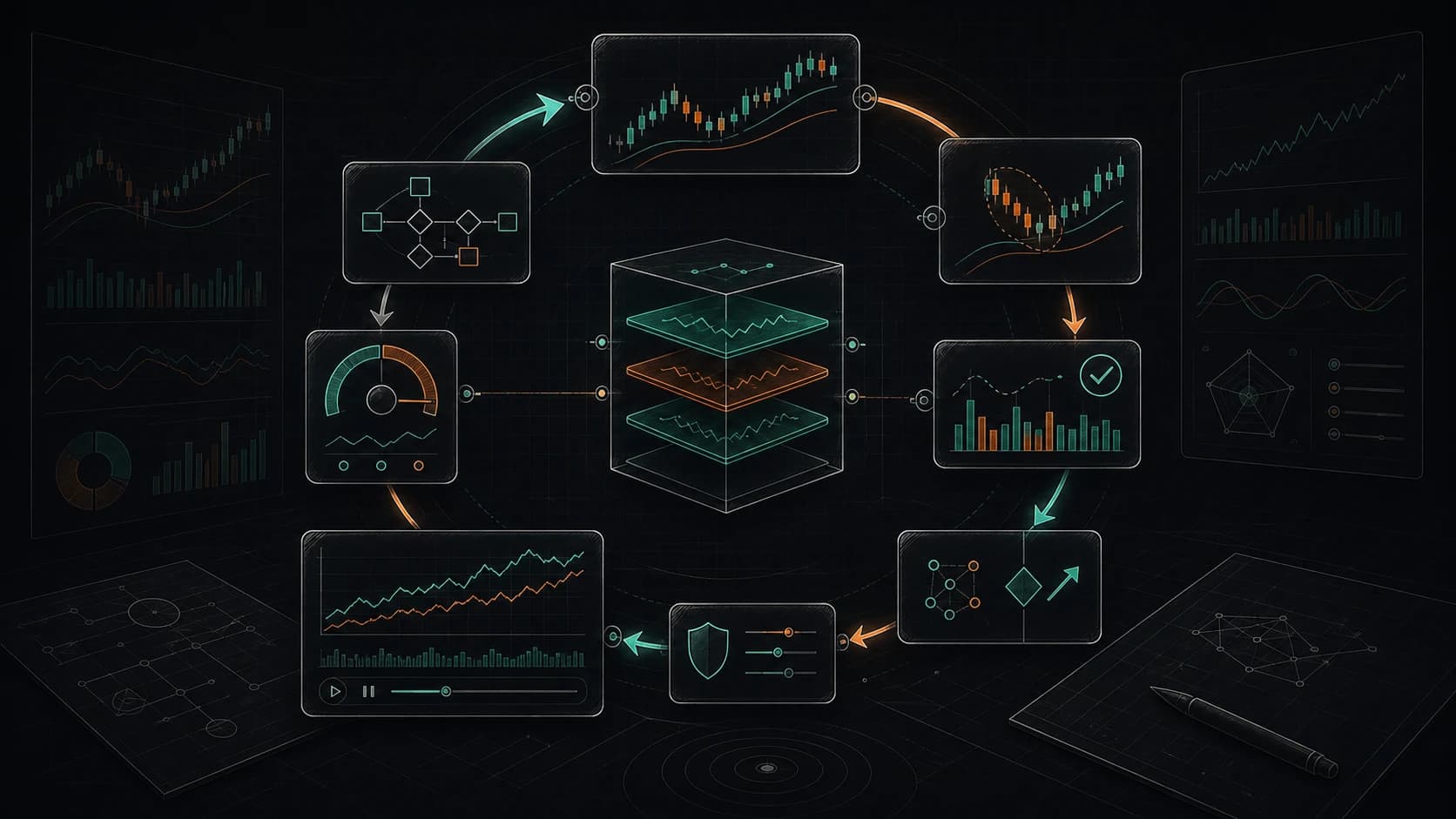
A typical research workflow may look like this:
Trend Filter

↓

Wait for Pullback

↓

Volume Confirmation

↓

Generate Trading Signal

↓

Run Backtest

↓

Analyze Results

↓

Optimize Blueprint

↓

Validate Again
Every step of the research process remains inside a single Blueprint.
If the results are unsatisfactory, there is no need to rewrite code from scratch.
Instead, you can continue refining:
- Indicator parameters
- Trend filters
- Risk management
- Position sizing
- Entry conditions
- Exit logic
Run another backtest.
Analyze the results.
Improve the Blueprint again.
Each iteration brings your trading logic closer to your original ideas.
Backtesting Is Not About Proving That a Strategy Makes Money
Many traders believe backtesting exists solely to identify the most profitable strategy.
Its true purpose is to answer much more important questions.
For example:
- Is the maximum drawdown acceptable?
- How many consecutive losing trades should be expected?
- Under which market conditions does the strategy perform best?
- When should the strategy stop trading?
- Is the overall risk well controlled?
These questions are often far more valuable than the final return.
Because any strategy intended for long-term deployment must first demonstrate one essential characteristic:
Stability.
The Real Value of Blueprint
Blueprint was never designed to help traders discover a so-called Holy Grail strategy.
Its true purpose is to help traders transform an idea into something that can be:
- Validated.
- Backtested.
- Continuously optimized.
- Executed automatically.
- Shared with others.
- Improved through ongoing research.
Trading is, at its core, a continuous process of testing hypotheses.
Every modification becomes a new experiment.
Every backtest becomes another validation.
Every optimization makes the trading logic stronger.
Conclusion
Great trading is not built upon one perfect prediction.
It is built through disciplined research, repeated testing, and continuous improvement.
Markets change every day.
No strategy can remain effective under every market condition forever.
Instead of constantly searching for new strategies, a better investment of your time is continuously refining your own trading methodology.
NavaX believes Blueprint should be more than just a strategy builder.
It should serve as a complete research platform that helps traders study, validate, optimize, and improve their trading ideas over time.
Because:
Great trading strategies are not discovered.
They are built through continuous research, backtesting, and refinement.